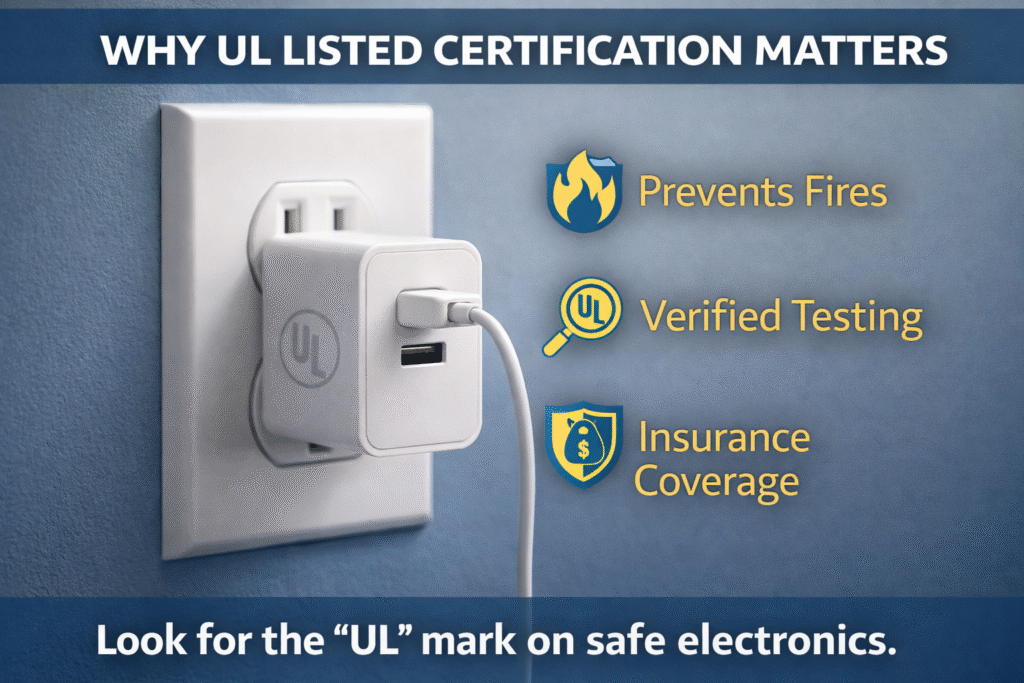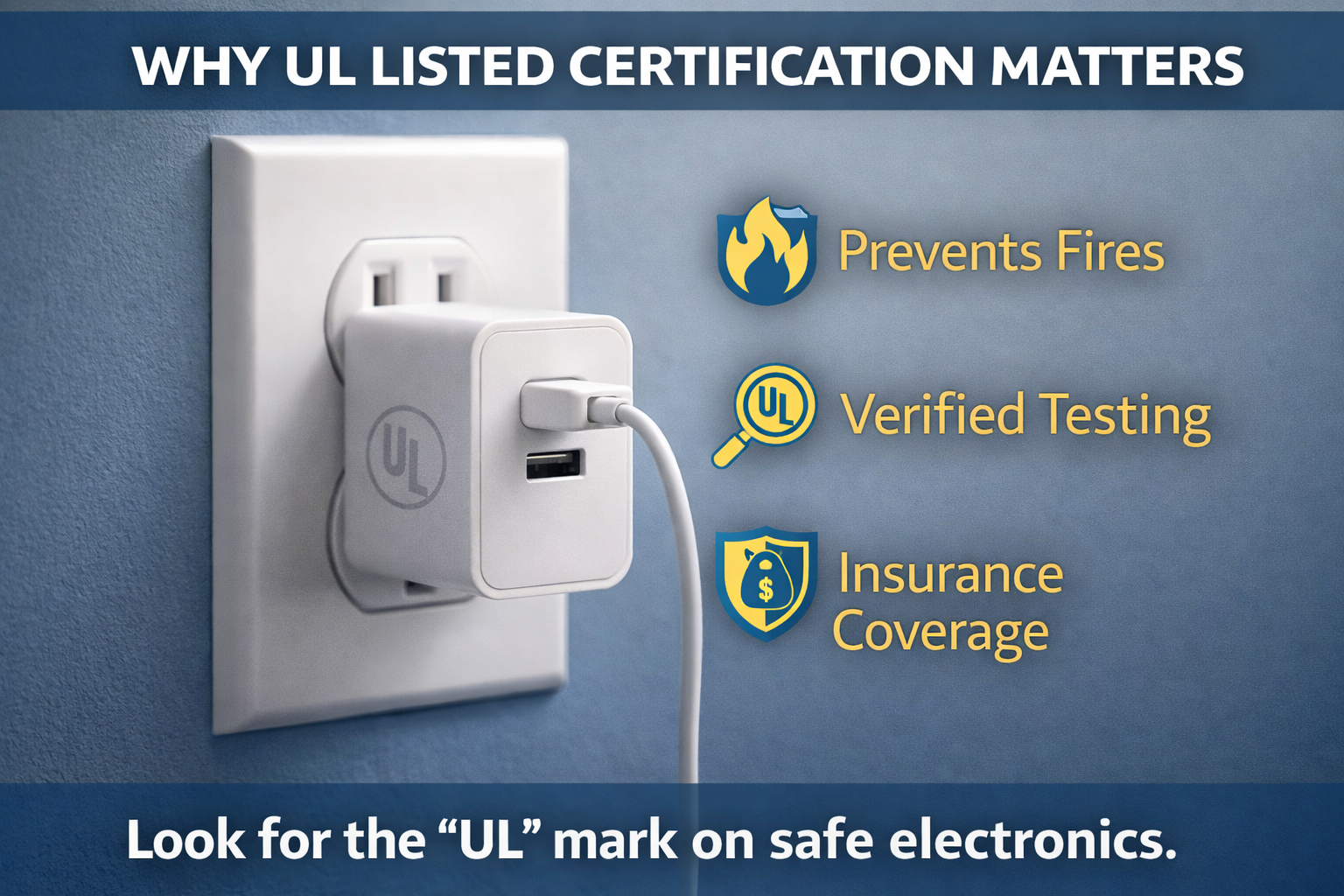
Look closely at your favorite phone charger for a tiny “UL” stamped inside a circle. That small mark is an invisible protector standing between your morning routine and a house fire. The letters stand for Underwriters Laboratories, an independent safety organization.
The easiest way to validate a claim is to verify it directly. UL provides a public lookup tool called Product iQ:
UL Product iQ.
If you want to review our own compliance documentation and certificates, you can also visit our
Certifications page.
What Does UL Stand For? The Independent Referees Behind Your Toaster
Underwriters Laboratories is a global leader in safety science, focused on testing products to determine what makes them safe or risky. Many consumers assume UL is a government agency, but it is an independent third party. That independence matters because it means a neutral lab verifies a manufacturer’s claims under controlled conditions.
Inside the Torture Test: How Your Appliances Earn the Safety Seal
Cheap discount electronics often skip verification. UL style certification tests evaluate the finished product, not only a single internal part. Typical evaluations include impact resistance, overheating scenarios, and surge conditions, plus ongoing factory compliance checks.
- Drop testing: verifies housing integrity after real-world falls.
- Thermal testing: checks overheating risk under heavy load.
- Surge testing: validates resilience to electrical spikes.
UL Listed vs. UL Recognized: The Difference That Prevents House Fires
A UL Recognized mark generally applies to components used inside finished products. A UL Listed mark typically applies to the final product tested as a complete unit. For consumers, “Listed” is usually the safer reference point for finished goods, because it reflects testing of the complete device rather than one part.
The Hidden Risks of Unverified Electronics and Insurance Denials
Unverified products can overheat and fail in ways that create fire risk. In addition, after an incident, insurers and investigators may assess whether the product met expected safety standards. Choosing certified products helps reduce both physical risk and downstream liability concerns.
Your 5-Minute Home Safety Audit: How to Verify Your Devices
Do a quick sweep of common high-draw items like chargers, heaters, and power strips. Then verify the mark and the manufacturer data in a trusted database.
- Check the plug: prongs should be solid, straight, and well-fixed.
- Inspect the logo: crisp printing, no misspellings, no blurry edges.
- Look for embossed marks: molded labels are harder to fake than stickers.
- Verify online: confirm the listing in UL Product iQ.
Buying With Confidence: A New Standard for a Safer Home
Use a simple rule: check for certification on high-load devices, avoid suspiciously cheap copies, and treat small price differences as insurance for your home. If you want more practical guides, you can browse our
Blog. If you have questions about compliance or product requirements, you can also
contact us.